
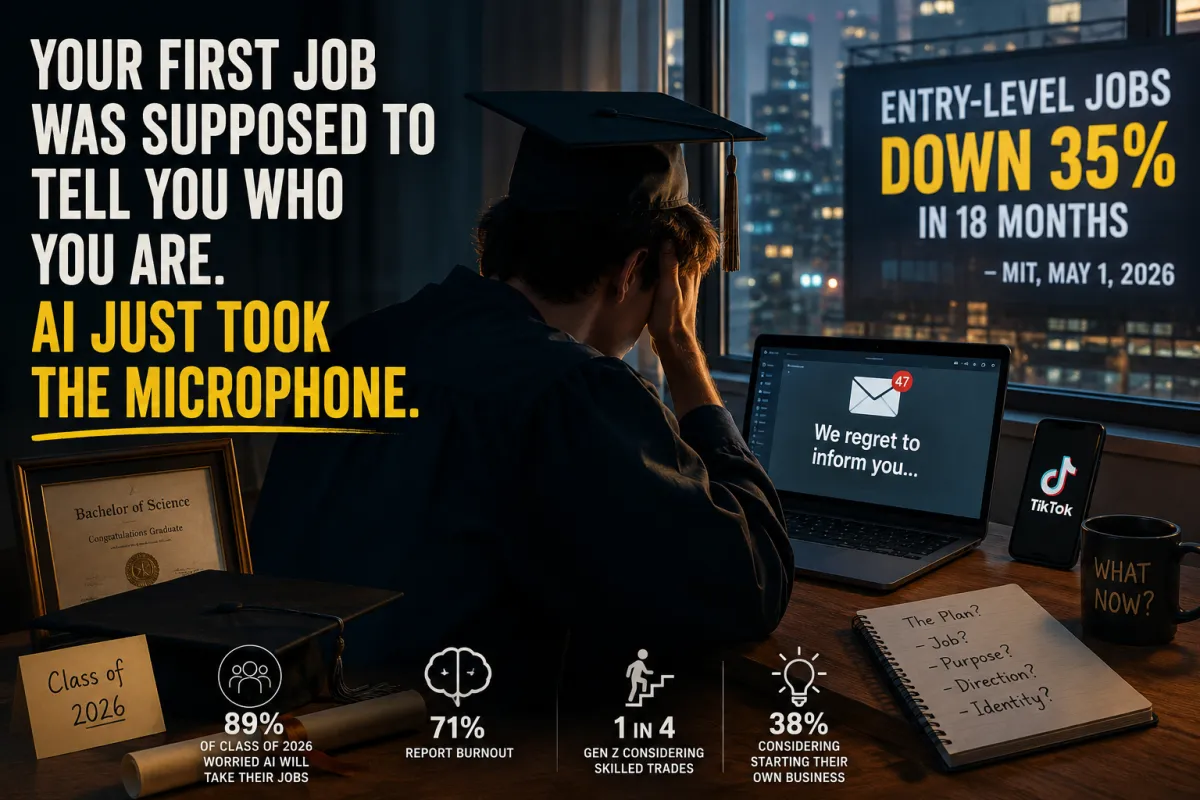
Your First Job Was Supposed to Tell You Who You Are. AI Just Took the Microphone.
It's 1:14 AM on Monday morning. You graduated Friday.
The cap is in a box somewhere. The diploma is on the kitchen counter in a frame your mom bought because no one else was going to. Your phone is open to an inbox that contains forty-seven versions of the same sentence: "We regret to inform you." You scroll TikTok because anything is better than the math you keep doing.
Here's what no one told you in your senior year.
Entry-level job postings in the US are down 35% in the last eighteen months, largely because of AI. Your class — the class of 2026 — is graduating into the worst job market since 2021. An MIT researcher named Andrew McAfee went public on May 1 to warn companies that automating the first rung of the ladder is going to break the whole pipeline. Eighty-nine percent of your graduating class is worried about exactly this. You're not paranoid. You're paying attention.
And underneath that fact is a quieter one. You spent four years preparing for a job that is, in some real sense, no longer there. The part of you that built an identity around being "the one who has a plan" is now standing in the middle of a parking lot with no car. That was supposed to be the year your identity finally caught up with your effort. The year the world said back to you: yes, this is who you are now. That return-message just got lost in a server somewhere.
You're not behind. You're not lazy. You're not bad at networking. The structure that was supposed to hand you back your sense of self stopped working while you were inside the library.
I talked to a 23-year-old last fall who'd been chasing a finance analyst role for nine months. Eighty-seven applications. Three interviews. Zero offers. She kept telling herself she was "not good enough yet." Then one night she opened a job description and saw the words "AI-assisted" in the third bullet. Then in the next role. And the next. And she did the small, painful math: the job she'd been training for wasn't being given to better candidates. It was being absorbed by a tool that didn't sleep.
The relief came in a really uncomfortable shape. Because if it wasn't her — if it really was the market — then the question stopped being "what's wrong with me?" and started being "who am I, if my plan was already obsolete the day I declared my major?"
That question is not a setback. That question is the actual beginning.
Here's what I want to offer you, gently, at 1:14 AM. The first job was never the thing. The first job was the proxy. You weren't trying to get hired by a Fortune 500 in May. You were trying to get a reflection back. You wanted a title that said: you exist, you matter, your years of effort were correctly aimed. AI didn't take your dream. It took the mirror that was supposed to confirm your dream.
That's where the work actually starts. Not in another round of applications. In the identity layer underneath them. That's the first pillar we walk through in the Identity to Income framework — the one that asks: what do you actually do that the world quietly needs, and who do you have to become to be paid for it on your own terms. Not your parents' terms. Not your roommate-now-at-Goldman's terms. Yours.
When you start there, the resume starts writing itself. The pitch becomes obvious. The pivot from "I applied for ninety jobs" to "I built one thing this week" stops feeling like failure. It starts feeling like the actual job.
Here's what's true. Your identity was never going to come from your first job title. AI just took away the polite lie that it was. The credential was the wrapper. You are not the wrapper.
Picture Monday morning, six months from now. You're not refreshing a job board. You're sending an invoice. Or a Loom. Or a deck. To one person who knows your name because you helped them with something specific and small and real. Your inbox doesn't have forty-seven rejection emails anymore. It has two replies that say "yes, send the next thing." You're not less anxious. You're just anxious about a different thing now. A thing you actually chose.
The cost of not doing this work right now is not unemployment. The cost is spending the next three years in a job you took out of panic, building someone else's identity, then waking up at 26 to do the same identity work with three more years of compound interest charged against your time.
The LXC Academy exists for exactly this moment — the late-night, "the plan I had no longer applies" moment. And the founding member round closes May 31. After that the rates go up, the cohort closes, and the next opening looks very different.
So here's what to do this week. First — tonight, before you close the laptop — write down the one specific thing you helped someone with in the last twelve months that they actually thanked you for. Not what your degree was in. What you actually did. That's the starter thread.
Second, if you want a book that names exactly what you're feeling and gives you language for the gap between the job you have (or don't) and the work you were actually built for, read Quitter by Jon Acuff. And if you want the deeper identity-and-habit layer underneath it — the playbook for becoming the person whose resume is implicit — Atomic Habits by James Clear is the cleanest one I know.
Third, if you want the actual framework and a room of people doing this work alongside you, the LXC Academy founding round is open until May 31. The Find Your Path tier — $127/mo at founding rate, going to $159 after the 31st — gives you the full 90-day Identity to Income walk-through, the recording library, and a community that is not LinkedIn. It's the version of "what next" that doesn't make you smaller.
Identity-aligned action wins every single time. Because you're not fighting against who you're meant to be.
Close the laptop. Drink some water. The world really did change while you were in the library. So did you. Tomorrow morning, you get to find out which version of you walks into it.
Some links above are Amazon affiliate links. If you buy through them I may earn a small commission at no extra cost to you.
